
Shea Butter
View product
This site uses cookies to measure which pages are useful.
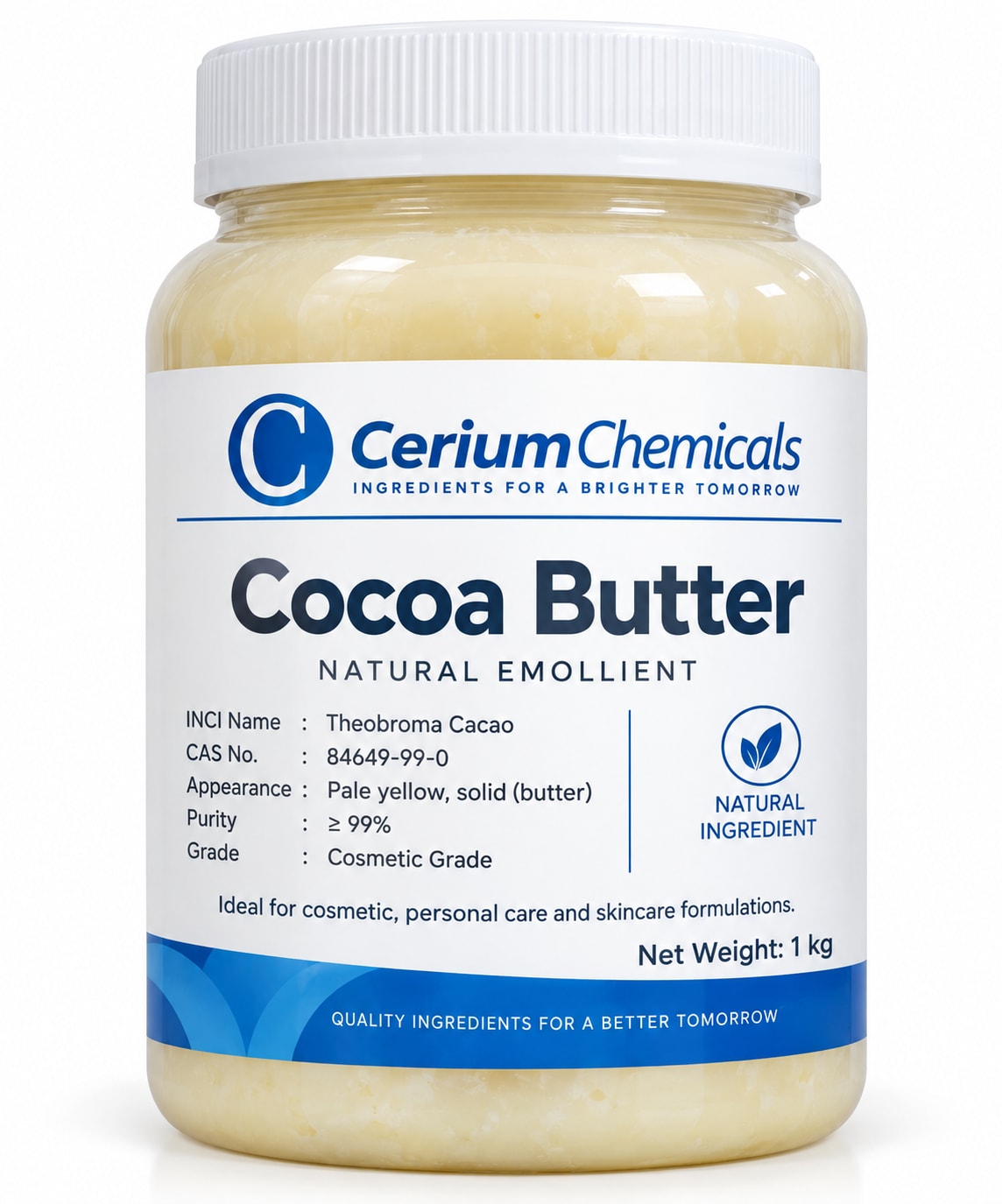
Butters
Cocoa butter is a natural fat extracted from the seeds of the Theobroma cacao plant, widely used in personal care formulations for its emollient and moisturizing properties.
Speak to the sales team about availability, pack sizes and pricing.
Emollient and moisturizer in skin care formulations.
Cocoa butter is a natural fat extracted from the seeds of the Theobroma cacao tree. The extraction process typically involves fermenting, drying, roasting, and pressing cocoa beans to separate the fat from the solids. This fat is then refined or left unrefined depending on the intended use.
The resulting butter is solid at room temperature but melts near human body temperature, providing a smooth and creamy feel when applied to the skin. It contains a mixture of fatty acids and natural antioxidants, which contribute to its emollient and protective properties in topical formulations. Cocoa butter is widely used in personal care due to its ability to hydrate and soften the skin while enhancing product texture.
Formulators choose cocoa butter to address skin dryness and improve skin softness by providing a lipid barrier that reduces moisture loss. Its natural fatty acids help nourish and hydrate the skin, making it suitable for products targeting dry or sensitive skin types. Compared to synthetic emollients, cocoa butter offers a plant-based alternative with additional antioxidant benefits.
However, cocoa butter's solid state at room temperature requires careful handling to ensure proper melting and incorporation into formulations. Its characteristic aroma and potential to clog pores can limit its use in certain facial products, prompting formulators to balance sensory qualities and skin compatibility. Despite these considerations, cocoa butter remains a valuable ingredient for enhancing texture and moisturising efficacy in a wide range of personal care products.
| Category | 100% Pure Natural Essential Oils, Carrier Oils and Butters |
|---|---|
| Product range | Butters |
| Applications | Skin Care |
| Application | How it is used |
|---|---|
| Body moisturisers | Cocoa butter is used to provide deep moisturisation and improve skin softness in body lotions and creams. |
| Lip care products | It acts as a nourishing emollient in lip balms, helping to protect and hydrate dry lips. |
| Hair conditioners | In hair care, cocoa butter helps to condition and soften hair strands, improving manageability. |
| Soaps and cleansing bars | Cocoa butter is incorporated to add moisturising properties and improve the hardness of soaps. |
| Massage oils and balms | Its smooth texture and emollient properties make it suitable for use in massage formulations. |
| Facial creams (with caution) | Used carefully in facial products to provide moisturisation, though its comedogenic nature requires formulation adjustments. |
| Body butters | Cocoa butter is a key ingredient in rich body butters, contributing to a thick, creamy texture and long-lasting hydration. |
Finished products this class of material is suited to. Talk to us about your formulation.
Specifications, handling and supply. Nothing on this page is hidden behind a control.
Cocoa butter should be handled in a well-ventilated area with appropriate protective equipment such as gloves to avoid skin contact during processing. It is best stored in sealed containers away from direct sunlight and heat sources to maintain its quality and prevent oxidation. Maintaining cool, dry storage conditions helps preserve its natural properties and extends usability.
General guidance. Always work from the safety data sheet supplied with your delivery — it is the document that governs, not this page.
Cerium Chemicals ensures that incoming cocoa butter is accompanied by supplier documentation and batch records to verify its origin and quality. The material is stored under controlled conditions to maintain its integrity until dispatched to customers. Regular stock rotation is practiced to ensure freshness and consistent supply.
Cerium Chemicals supplies cocoa butter from Nairobi, offering access to this natural ingredient within the local market. The company supports formulators with a range of natural and botanical ingredients, ensuring reliable sourcing and availability. Technical assistance is available to help integrate cocoa butter effectively into personal care formulations.
Cerium supplies formulators across East and Central Africa, dispatched from Industrial Area. Delivery times and freight depend on the pack size and the destination, so they are quoted with your order rather than guessed at here.
Independent background on this class of material. These are third-party pages: nothing on them describes Cerium’s material or its specification.
Materials Cerium supplies for similar work. They are not alternatives or substitutes — nothing in the supplied data establishes that any two products are interchangeable.
Talk to our sales team about availability, pack sizes, delivery and pricing.
Prefer to write? Send an enquiry about Cocoa Butter